



The first 100 days after close are when people risk becomes value risk—or value creation. Private equity teams invest heavily in financial and operational workstreams, yet integration stalls when HR due diligence findings sit in a deck instead of becoming a clear execution plan. The goal isn’t to “do HR.” The goal is to protect continuity, stabilize the workforce, and build an operating model that can scale the investment thesis.
A strong 100-day plan translates HR due diligence into time-bound actions, clear owners, and measurable outcomes. It also aligns operating partners and portfolio leadership on what must happen immediately versus what can wait. Below is a practical playbook to move from diligence insights to a post-acquisition plan that supports growth, reduces surprises, and sets the integration up for speed.
Convert HR due diligence findings into value-risk priorities
HR due diligence often uncovers a mix of compliance gaps, leadership weaknesses, compensation misalignment, fragile employee relations, and systems debt. The mistake is treating these as an HR to-do list. Operating partners need a value lens: what threatens near-term business continuity, what blocks the investment thesis, and what creates reputational or legal exposure.
Start by mapping each diligence finding to a business outcome. Payroll and benefits issues threaten employee trust and retention. Misclassified workers, incomplete I-9s, or wage-and-hour vulnerabilities create direct deal risk. Leadership and org design gaps impair decision velocity at exactly the moment integration requires it most. Inconsistent performance management and unclear incentives blunt growth initiatives.
From there, build a tight set of priorities that can be executed in the first 100 days. In practice, most plans are anchored in four categories: stabilize the workforce, control compliance and people risk, align leadership and structure, and establish the HR operating foundation. This is also where operating partner services add leverage—by forcing tradeoffs, sequencing workstreams, and ensuring actions are tied to EBITDA impact, integration milestones, and employee experience.
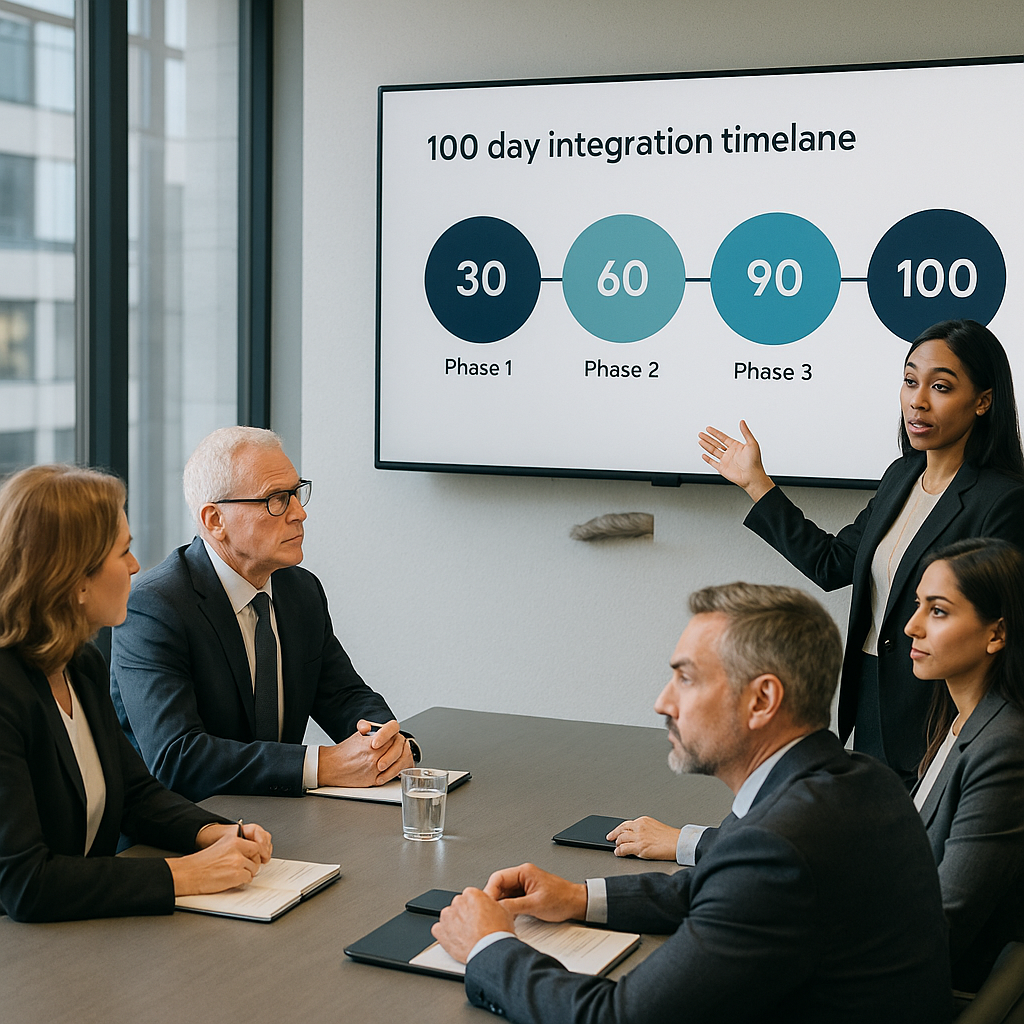
Design the 100-day plan around three phases of execution
Effective 100-day plans are not a single sprint. They are a phased approach that matches how information, access, and change capacity evolve after close. This is the difference between a thoughtful post-merger integration and a reactive scramble.
The first month is stabilization and control. Employees want to know what changes on day one, how they get paid, who they report to, and whether benefits remain intact. This is the moment for clean communications, leadership visibility, and immediate fixes that prevent avoidable churn. It’s also when you lock down critical compliance tasks: worker classification checks, policy gaps that create exposure, documentation cleanup, and confirming HR data integrity.
The middle period shifts to alignment and integration. As you gain better visibility into the organization, focus moves to the operating model: clarifying decision rights, tightening spans and layers, and ensuring incentives support the plan. If the deal involves integration with a platform, this is when you harmonize core programs without breaking trust—job architecture, performance cycles, compensation philosophy, and benefits strategy. It’s also when you begin addressing cultural friction points identified in diligence, not with slogans, but with concrete management behaviors and operating rhythms.
The final phase is foundation-building for scale. This is where HR consulting work pays off through durable systems and processes: a reliable HRIS roadmap, reporting and dashboards, manager enablement, and repeatable talent processes. The goal at day 100 is not perfection. It’s having a stable baseline and a clear backlog that leadership agrees to fund and execute.
Put governance behind the plan: owners, cadence, and metrics
A 100-day plan only works if it is run like an operating playbook. That means real ownership, weekly cadence, and metrics that show whether people risks are shrinking and value creation is accelerating.
Assign a single accountable executive sponsor—often the CEO or operating partner—with an HR leader as the day-to-day driver. If the company lacks strong HR leadership, fractional HR support is often the fastest way to create momentum without waiting for a full-time hire. The HR workstream should connect tightly to finance, legal, and IT, because many high-risk diligence items live at the intersections: payroll controls, benefits contracts, employee data, and policy enforcement.
Create a short, consistent operating rhythm. A weekly integration huddle keeps dependencies visible and prevents drift. A monthly steering review keeps leadership aligned on tradeoffs, resourcing, and decision points. Most importantly, define what “done” looks like. Track employee retention in critical roles, time-to-fill for key hires, payroll accuracy, completion of compliance remediation, manager adoption of performance routines, and integration milestones such as harmonized policies or benefits transitions. These are leading indicators that your post-merger integration is either earning trust or burning it.

Execute the work that protects trust and unlocks the thesis
In the first 100 days, the highest returns often come from a few well-executed moves. Stabilize compensation and benefits administration so employees experience competence immediately. Establish clear leadership expectations and communication norms so managers don’t create confusion through silence or inconsistency. Clarify org design and role accountabilities so teams can make decisions quickly.
Then address the “quiet” risks diligence revealed. If policies are outdated or unenforced, update them and train managers on what changes in practice. If the workforce is heavily contractor-based or misclassified, remediate with legal guidance and a communication plan that minimizes disruption. If talent is thin in finance, sales leadership, or operations, launch targeted recruiting and retention actions early; waiting until day 90 is how growth stalls.
Finally, create the HR foundation the company needs to scale. Even a light lift—standardized onboarding, a basic performance check-in cadence, clean employee data, and a simple people dashboard—can materially improve execution. A 100-day plan is successful when it makes the business easier to run, not when it produces a binder of HR documents.
The operating partner’s job is to turn insight into action. HR due diligence gives you the map; the 100-day plan is how you move. When you prioritize the right risks, sequence change intelligently, and run governance with discipline, HR becomes a driver of integration speed and value creation—not a downstream clean-up effort. If you want the first 100 days to protect the deal and accelerate the thesis, make the people plan as executable as the financial plan, and resource it accordingly.
Why 29Bison?
Choosing the right partner for HR due diligence and integration is critical to the success of any transaction, and 29Bison offers unmatched expertise and support in navigating these complexities. With a people-first approach, we go beyond traditional due diligence to address not only workforce-related risks but also opportunities that drive long-term value creation. Our comprehensive HR due diligence services uncover hidden risks, optimize workforce strategies, and identify synergies that align with your strategic objectives. Post-transaction, we provide tailored HR integration solutions designed to foster a seamless transition, retain key talent, and build a cohesive organizational culture that supports sustainable growth. And finally, 29Bison's Fractional HR Operating Partner service provides private equity firms with strategic, high-impact HR leadership, driving value creation, talent optimization, and seamless workforce integration across portfolio companies.
At 29Bison, we're more than human capital consultants—we're partners invested in helping you achieve your vision by maximizing the potential of your most valuable asset: your people. Let us help you turn challenges into opportunities and create a solid foundation for success. Reach out today to learn how we can support your HR diligence and integration needs.