



You’re about to sign an LOI on an add-on, and you need to decide how much people-risk you’re willing to inherit on Day 1. Financial diligence will tell you what you’re paying for. Human capital diligence tells you what you’ll spend time, money, and leadership attention fixing—often under a tight integration clock.
A 29Bison human capital diligence report is built to answer a practical question for PE sponsors and portfolio operators running an add-on strategy: what’s the real workforce and HR exposure, what’s actionable before close, and what needs a 30/60/90-day plan so the platform doesn’t absorb avoidable liability.
Engagement overview: what we reviewed and what we didn’t
The report starts by laying out the scope so you can judge the findings in context. We document the transaction parties and the deal timing, then map what information we requested and received.
This matters more than it sounds. In add-on deals, the HR story is often fragmented—different sites using different timekeeping methods, scattered employee files, or payroll data that exists only as “current state” without history. The report calls that out early, because a clean “no issues found” statement is meaningless if the underlying data can’t support it.
We also include the standard diligence qualifiers: the analysis is based on information provided in the data room or by deal participants, and it’s not legal, tax, or accounting advice. Where a finding crosses into legal interpretation or regulatory exposure, the report flags that and advises involving qualified counsel.

Risks and opportunities analysis: a prioritized heat map, not a data dump
The core of the report is a prioritized risks and opportunities register, sorted by timing and severity. It’s designed for deal teams who need to make decisions, not just collect documents.
You’ll see items categorized by when you should act—pre-close, first 30 days, first 90 days, and 90+ days. Each entry includes what we saw, why it matters, and what a reasonable first move looks like.
Examples from the sample report show the kinds of issues that can materially change the Day 1 burden for a platform company. Employment eligibility gaps can create successor-liability exposure if Form I-9 or E-Verify records are missing or incomplete. FLSA classification concerns—especially when state-specific salary thresholds apply—can translate into back wages, penalties, and knock-on impacts to benefits and taxes. Contractor and 1099 practices can create misclassification and reporting risk that doesn’t stay contained to the target; it spreads when you try to standardize vendors and onboarding across the platform.
Operational controls show up here too, because they drive both compliance and scalability. A decentralized time and attendance process—texts, calls, spreadsheets, inconsistent site-by-site practice—creates wage-and-hour exposure and makes payroll hard to defend in an audit. An HRIS that holds only “point-in-time” records without employee history limits your ability to validate pay changes, promotions, or transfers and makes integration reporting painful.
If the target has collective bargaining agreements, the report treats them as a serious diligence item, not a footnote. Multiple CBAs can constrain workforce flexibility post-close, raise the cost of operational changes, and create immediate obligations you inherit as the successor.
120-day integration roadmap: what to do first so the platform can keep buying
Most diligence reports stop at “here are the problems.” That’s not enough for an add-on strategy. You need an integration plan that sequences work, assigns owners, and produces artifacts your platform can reuse on the next acquisition.
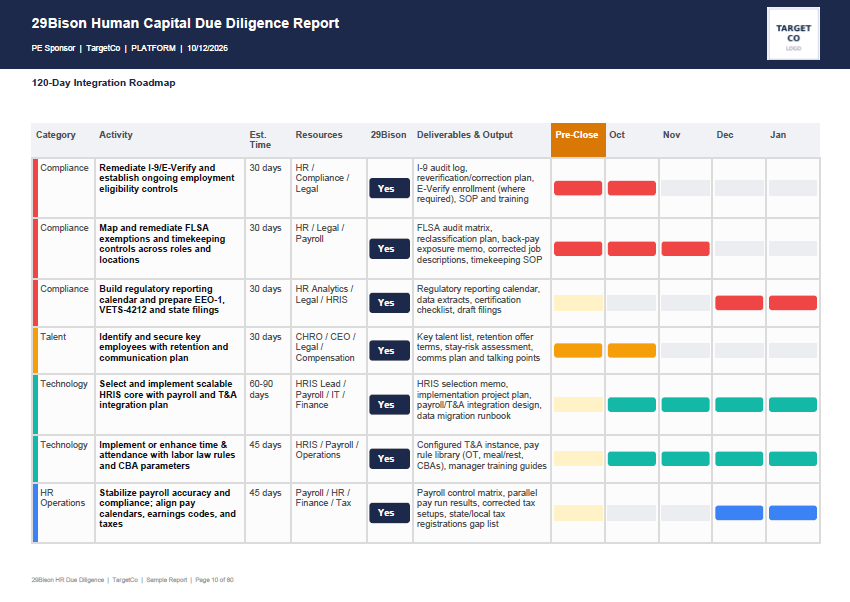
The report includes a 120-day integration roadmap by category—compliance, talent, technology, HR operations, and benefits—with estimated effort, required resources, and concrete deliverables.
In the sample, early roadmap items include cleaning up I-9/E-Verify controls, mapping FLSA exemptions and timekeeping rules, and building a regulatory reporting calendar. Those are “quiet” fixes, but they prevent expensive noise later.
The technology workstream is where platform discipline shows. If payroll is run in-house with manual time entry and limited audit history, or the HRIS can’t store employee lifecycle changes, the roadmap pushes toward selecting and implementing scalable systems and designing payroll/timekeeping integration. The point isn’t to create a perfect tech stack in 120 days; it’s to establish control, auditability, and a repeatable playbook for the next add-on.
There’s also an explicit focus on key employee retention and communications planning. If you lose the people who actually know how work gets done right after close, every other integration initiative slows down.
Workforce, benefits, and handbook views: the details that change your cost and risk
The report includes supporting sections that help you validate the size and shape of what you’re buying and pressure-test whether the target can operate inside your platform standards.
The data request checklist shows which diligence inputs were provided and which were missing or not applicable. That becomes a working tool for the deal team, especially when last-minute data arrives or when you need to tie open items to closing conditions.
The benefits summary captures plan details at a practical level—carrier, plan design, employee/employer contributions, and observations that affect employee impact and integration planning. When there’s an obvious limitation—such as a single medical option without an HDHP/HSA path—the report notes it as an integration decision, not a philosophical critique.
The employee census and workforce analysis provide a structured view of the employee population, including role and pay fields and demographic breakdowns. For PE teams, this helps with integration planning, compliance questions, and basic “do we trust the underlying employee data?” validation.
Finally, the handbook assessment looks at compliance readiness and operational defensibility. In the sample report, the handbook review evaluates dozens of items and flags where multi-state requirements are not reflected in wage-and-hour rules, paid leave frameworks, pay practices, and administrative controls like acknowledgment and version tracking. This section is especially useful when you’re trying to harmonize policies across a platform while avoiding avoidable wage-and-hour and leave exposure.
If you’re actively acquiring add-ons, the next step is simple: download the sample human capital due diligence report and compare it to what you’re currently getting from HR diligence. Use it as a checklist for your next deal kickoff and as a template for turning findings into a 120-day integration plan your operators can actually run.
Download the sample report below.

Why 29Bison?
People decisions can change the outcome of a deal. 29Bison helps private equity firms and business leaders assess workforce risks before close, plan HR integration after an acquisition, and evaluate leadership and culture. Our Fractional HR Operating Partner service provides HR leadership across portfolio companies.
If you're preparing for a transaction or deciding what your HR team needs next, talk with 29Bison about the people questions you need to answer.